Saturday, September 23, 2006

Media drives happiness - designing inspiring online platforms
For some time now, my grandmother is having problems with her eyesight. During this time, she's having problem reading and enjoys German audio books very much. She can use them to re-cap on childhood books she had forgotten, or on large classics she didn't find the time to read.

A few months ago, my dad asked me if I could find some mp3s of piyutim (Jewish prayers) from Turkish synagogues in Israel recorded at Yom Kipur. He said that my grandfather (from my father's Turkish side) loves hearing prayers on tape and perhaps I "could find some on the Internet".
At first, I told my father's there's no way I could find such extremely specific content online. German audio books were reasonably popular, but Hebrew mp3 recordings of Jewish prayers taken at Turkish synagogues? that's completely nuts.
I told him that finding audio book versions of popular geeky-stuff is very easy. stuff like Tolkien's LOTR is all over the place, but what he was asking was just too much for conventional media availability on the net.

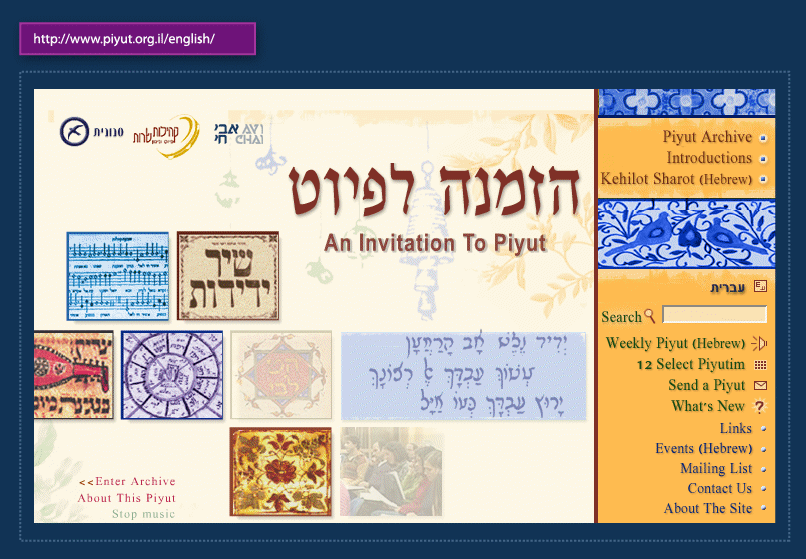
A few months later I read in Haaretz about a site called piyut. It took me a few minutes to realize what it was all about, but when I followed the link to the site I found a categorized list of recordings. I was quickly able to download about 140mb of recordings and burn them for grandpa.

My grandpa was thrilled. He keeps talking about the 2 audio-cds I burnt for him and listens to them again and again.

The fact I could actually find these exact recordings (Turkish, from Yom Kipur, no less) on the net is astounding. It was simply incredible. Sometimes web/software platforms enable great things. This is clearly the case here.

Certain types of media can touch our lives. They can drive happiness. Certain software/online platforms can make this possible. piyut made my grandpa happier. He's not even aware of the files' origin, but they excite him nonetheless.
Designers and developers can create platforms that truly excite people. These platforms deserve to be acknowledged so we can analyze their success and be inspired.
What platforms do you find inspiring?

Labels: , , , , ,

Saturday, September 16, 2006

Life, Death & Visual Indication


This is a story of a life, death and worrying sick due to a wrong visual indication.

Some time ago, my grandmother went through heart surgery. During the surgery, me and my family were sitting in the waiting room and watching the surgery board. The surgery board lists patients' initials and their current status. It has only 6 lines and multiple 'pages' that rotate every 20 seconds or so.

The patient status can be one of 3 values:
  • in surgery
  • in recovery (still inside the surgery room, but surgery is done and patient is recovering.)
  • transferred back to department (which means recovery is done and patient is transferred back to his department for further treatment.)
In addition to the board indication, when an operation is finished, a doctor comes out of the surgery room and talks to the relatives about the results of the surgery.

Normally, a patient goes from being in surgery to being in recovery and then being transferred back to department. some time after that, the patient's name is removed from the board.
When we arrived to the waiting room, we saw my grandma's initials on the board and the status said "in surgery". 40 minutes later however, the name was suddenly removed from the board.
When I suddenly noticed the name was removed (3 pages flipped by and she wasn't there), I thought it's probably just a mis-update or an update lag. I figured the silly software that updates the board from remote probably removes the name and then re-adds it later with the new status, but I waited about 5 mins and the name didn't return to the list.
I then told my parents that the name was removed and they slowly started to freak out.
It started to look really bad, we waited a few more minutes and then rang the intercom outside the surgery room. It took a few minutes for a nurse to come out and during those minutes my brother and mother already started crying.
When the nurse came back she told us the surgery was successful & grandma had already been transferred back to her department.
At that point I started to be really upset. The stupid indication on the board made my family worry that grandma's surgery had failed, and it was only due to a mis-feed of data.
We finally realised that the doctor came out of the surgery room early and didn't find us, then someone forgot to update the board leaving the status 'in surgery'. When someone finally noticed the status was wrong, he simply removed the line from the board.
This is a case of a visual indication gone terribly wrong. But it can also demonstrate the way in which people interact with computer applications. The person in-charge of updating the board forgot to update it initially - which made the displayed status irrelevant, only to later remove the entire row and render the status terribly terribly wrong.

A few questions come to mind:
  • should the application allow the user to delete the patient's entry when it's in status in surgery?
  • Within the surgery staff, who should be responsible for updating patient's status?
  • Is there a way to avoid such errors in the future?
  • Was the problem inevitable or perhaps an interface change could prevent it?

Labels: , , , , , ,
